The Founder
Tristan Cezair
Canadian Screen Award–winning immersive filmmaker, creative technologist, AI systems builder, inventor, and founder… known for pioneering work at the intersection of storytelling, emerging technology, and experiential media.
For more than fifteen years, Tristan has built where film, television, VFX, XR, immersive media, and AI systems meet… merging cinematic storytelling with advanced technology long before those disciplines became mainstream. A pioneer of 360° filmmaking and immersive storytelling, he has shot, presented, and taught the work worldwide. As Creative & Technical Director at Cream Productions, his work spans award-winning productions, immersive documentaries, interactive installations, and AI-driven systems across North America and internationally.
His recognition includes a Canadian Screen Award (as winner, and later a two-year judge), a Gold W3 Award, a feature at the Computer History Museum, and patented avatar and human–computer interaction technologies. He has held advisory and mentorship roles with George Brown College and Seneca Polytechnic in VFX, digital media, immersive technology, and AI.
His most recent work turns that same instinct on the craft itself: he doesn’t only build with these tools… he builds the systems that build. Over years he architected a personal, vendor-agnostic agentic infrastructure: an integrated stack of AI and automation that runs the day-to-day and, in turn, helps design and scaffold what comes next. The constant across his career, layering the digital world onto the physical, from projection mapping to virtual and mixed reality, now extends into agentic XR: research with Durham College’s Mixed Reality Capture Studio on a hands-free bridge between a person and that system, out in the real world.
He is a lifelong maker. The through-line of the whole record is the same one Lighthouse is built on: taking things that exist as feelings… wonder, presence, connection… and engineering them into structures people can actually step inside.
The newest thing he builds is the hardest one: the infrastructure of belief and hope itself… researched, engineered, and lived. He builds the structure. Whether that makes him an architect of belief is for the people it holds to decide.
02The fight
Built from inside it
Tristan is building all of this through an active cancer fight. Not after it… through it. The manifesto is being written from inside the fight; the documentary is being recorded from inside it; the tools are being built between treatments.
The diagnosis didn’t author any of this. It was the ignition. The instinct to build was always there; the strike released it, and the whole universe came out of the fight, not in spite of it. That’s the part worth holding onto: what looks like the end of a life can change the unit it’s measured in, from length to depth.
A stroke in his own history is why Reach exists the way it does: the rehabilitation the instrument tracks is rehabilitation he does himself, daily. The empathy in the design isn’t researched… it’s lived, and then engineered.
He builds it for the people he loves, and for everyone he’ll never meet who is standing in the same dark.
He would be the first to say the work should speak instead of him. So: the work.
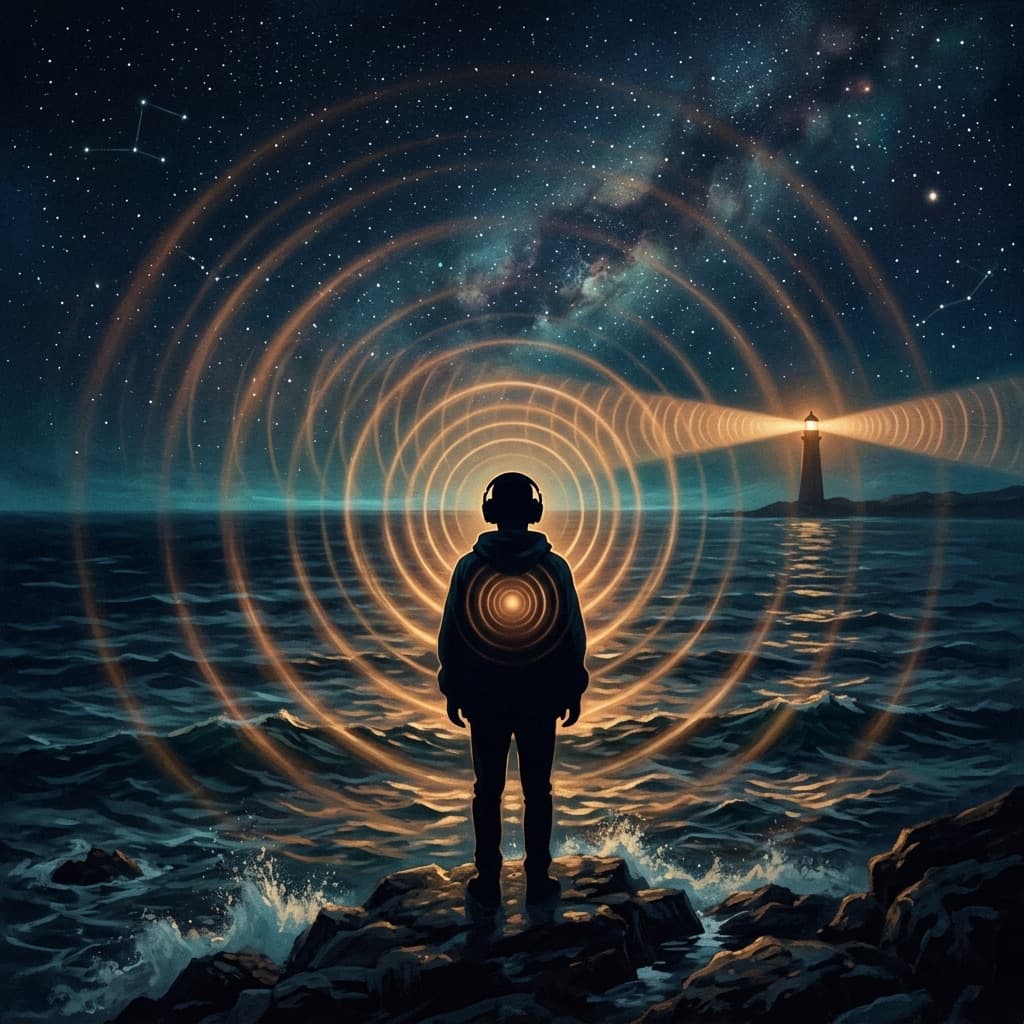
Standing in the beam… building the light from inside the dark it answers.
It isn’t the résumé that matters here. It’s the convergence… a builder, a filmmaker, and a patient, all one person, all building the same thing.
Why he’s building it: the mission →